Snickers, Charmin, DiGiorno, Cover Girl, Honda...like grains of sand, the list of brand names in our society is endless. Is there a rule for capitalizing brand names? You'd better believe it! Here's the rule:
Capitalize all important words in the brand names of business products.
*Note: Except in advertising displays, a common noun or adjective following a brand name is not capitalized.
Examples:
Oil of Olay
Crest toothpaste
Dial soap
Fruit of the Loom
Dodge pickup truck
Revlon lipstick
Honey Bunches of Oats with Almonds
Fruit 'n Fiber
Calvin Klein
Speedo swimsuits
Speedo LZ Racer Elite
Thursday, July 19, 2012


Thursday, June 14, 2012
Is It Time for a Colonoscopy?
Most folks will agree that everyone should incorporate annual medical exams and wellness programs into their lives. Have you, however, checked on your colon grammar health lately, or is it time for a writer's checkup?
Here are the major rules for using a colon if you need a colonoscopy to refresh your skills.
1. Use a colon to mean "note what follows."
A. Use a colon before a list of items, especially after expressions like as follows and the following.
EXAMPLES
The application for employment at the manufacturing plant asked the following questions: How old are you? Have you ever worked in a manufacturing plant before? What other jobs have you held?
We assembled the following items for our garage sale: lamps, books, records, toys, sheets and towels, dishes, and patio chairs.
* When a list immediately follows a verb or preposition, do not use a colon.
EXAMPLES
The emergency kit included safety flares, jumper cables, and a flashlight.
Each student taking the math test was provided with two sharpened pencils, paper, a protractor, and a ruler.
B. Use a colon before a long, formal statement or quotation.
EXAMPLES
Patrick Henry concluded his revolutionary speech before the Virginia House of Burgesses with these ringing words: Is life so dear, or peace so sweet as to be purchased at the price of chains and slavery? Forbid it, Almighty God! I know not what course others may take; but, as for me, give me liberty or give me death! (Note a formal statement like this need not be enclosed in quotation marks.)
Here are the four main uses of the comma: (1) to prevent misreading, (2) to separate items in a series, (3) to set off expressions that interrupt the sentence, and (4) to set off introductory phrases and clauses.
* The first word of a formal statement following a colon is generally capitalized; however, in the case of informal statements, the first word often starts with a small letter.
C. Use a colon between independent clauses when the second clause explains or restates the idea of the first.
EXAMPLES
Lois felt that she had accomplished something worthwhile: she had designed and sewn her first garment.
Benjamin Franklin had many talents: he was an inventor, a writer, a politician, and a philosopher.
2. Use a colon in certain conventional situations.
A. Use a colon between the hour and the minute when you write the time.
EXAMPLE 5:20 P.M.
B. Use a colon between chapter and verse in referring to passages from the Bible.
EXAMPLE Proverbs 10:1
C. Use a colon between volume and the number or between volume and page number of a periodical.
EXAMPLE Science Digest 102:3
D. Use a colon after the salutation of a business letter.
EXAMPLES Dear Mrs. Rodriguez: Dear Sir:
I hope the colon checkup will provide you with much better health in your writing.
Here are the major rules for using a colon if you need a colonoscopy to refresh your skills.
1. Use a colon to mean "note what follows."
A. Use a colon before a list of items, especially after expressions like as follows and the following.
EXAMPLES
The application for employment at the manufacturing plant asked the following questions: How old are you? Have you ever worked in a manufacturing plant before? What other jobs have you held?
We assembled the following items for our garage sale: lamps, books, records, toys, sheets and towels, dishes, and patio chairs.
* When a list immediately follows a verb or preposition, do not use a colon.
EXAMPLES
The emergency kit included safety flares, jumper cables, and a flashlight.
Each student taking the math test was provided with two sharpened pencils, paper, a protractor, and a ruler.
B. Use a colon before a long, formal statement or quotation.
EXAMPLES
Patrick Henry concluded his revolutionary speech before the Virginia House of Burgesses with these ringing words: Is life so dear, or peace so sweet as to be purchased at the price of chains and slavery? Forbid it, Almighty God! I know not what course others may take; but, as for me, give me liberty or give me death! (Note a formal statement like this need not be enclosed in quotation marks.)
Here are the four main uses of the comma: (1) to prevent misreading, (2) to separate items in a series, (3) to set off expressions that interrupt the sentence, and (4) to set off introductory phrases and clauses.
* The first word of a formal statement following a colon is generally capitalized; however, in the case of informal statements, the first word often starts with a small letter.
C. Use a colon between independent clauses when the second clause explains or restates the idea of the first.
EXAMPLES
Lois felt that she had accomplished something worthwhile: she had designed and sewn her first garment.
Benjamin Franklin had many talents: he was an inventor, a writer, a politician, and a philosopher.
2. Use a colon in certain conventional situations.
A. Use a colon between the hour and the minute when you write the time.
EXAMPLE 5:20 P.M.
B. Use a colon between chapter and verse in referring to passages from the Bible.
EXAMPLE Proverbs 10:1
C. Use a colon between volume and the number or between volume and page number of a periodical.
EXAMPLE Science Digest 102:3
D. Use a colon after the salutation of a business letter.
EXAMPLES Dear Mrs. Rodriguez: Dear Sir:
I hope the colon checkup will provide you with much better health in your writing.
Tuesday, June 12, 2012

Sunday, May 20, 2012
Job Skill -- Need Good Grammar!
Sometimes it's hard for people, particularly young folks, to see the big picture or, to use another cliche, to see the light at the end of the tunnel -- people don't always understand why they might need to learn something. Grammar is everywhere, and good grammar skills are important in many ways we don't always envision.
Yep, this is an embarrassing Oops! (Thanks, Web English Teacher for the pic.)

Yep, this is an embarrassing Oops! (Thanks, Web English Teacher for the pic.)

Wednesday, May 2, 2012
Holy Cow! Capitalization Words Referring to the Deity
Just a quick reminder to writers...
Capitalize words referring to the Deity.
Examples: God, Jehovah, the Father, the Son, the Messiah, the Almighty, the Lord
Pronouns referring to God (he, him, and, rarely, who, whom, etc.) are often capitalized.
Examples:
Faith in God rests on belief in His goodness.
For He cometh, He cometh to judge the earth.
* Do not capitalize god when referring to the gods of ancient mythology.
Example:
Homer writes about many of the Greek gods and goddesses in The Iliad and The Odyssey.
Happy writing, and let me leave you with food for thought: "We are all apprentices in a craft where no one ever becomes a master." ~ Ernest Hemingway
Capitalize words referring to the Deity.
Examples: God, Jehovah, the Father, the Son, the Messiah, the Almighty, the Lord
Pronouns referring to God (he, him, and, rarely, who, whom, etc.) are often capitalized.
Examples:
Faith in God rests on belief in His goodness.
For He cometh, He cometh to judge the earth.
* Do not capitalize god when referring to the gods of ancient mythology.
Example:
Homer writes about many of the Greek gods and goddesses in The Iliad and The Odyssey.
Happy writing, and let me leave you with food for thought: "We are all apprentices in a craft where no one ever becomes a master." ~ Ernest Hemingway
Tuesday, April 3, 2012
Numbers -- Manuscript Form
1, 2, 3, 4.... Numbers! Numbers are everywhere, and I'm not talking about just at the bottom of a page.
Authors need to fine-tune their craft by reviewing the rules for using numbers in writing. So, without further ado, I present to you the rules for using numbers in manuscript form:
Rules:
1. Do not begin a sentence with a numeral.
Nonstandard: 42 students ride the school bus each morning.
Standard: Forty-two students ride the school bus each morning.
2. Spell out numbers that can be expressed in one or two words. Write numbers that require more than two words as numerals.
Examples:
five million; forty-five cents; sixty dollars; eighty-three; 1,685,342; 1954; $342.58
Exceptions:
In statistical and technical writing, all numbers are generally written as numerals.
Page numbers are always written as numerals (page 10).
Numbers representing days of the month do no follow this rule, but those representing years do.
3. Hyphenate all compound (two-word) numbers from twenty-one to ninety-nine. Do not hyphenate a fraction unless it is used as an adjective.
Examples:
There are thirty-five students in my English class.
A three-fourths quorum was necessary to vote on changes to the club's bylaws.
Only one third of the registered voters came to the polls.
4. Write out numbers like third, forty-first, etc., rather than writing them as numerals with letter endings (3rd, 41st, etc.).
Example:
The movie actress was celebrating her fifty-second anniversary in show business.
Exception:
Numbered street names may be either written out or written as numerals with letter endings.
Dr. Winter's office is located at 651 East 62nd Street (or Sixty-second Street).
In dates, numerals only are used when the name of a month precedes the date. When the date precedes the name of the month or stands alone, either write out the number or use a numeral with a letter ending.
Examples:
The first day of winter is December 21.
Jack will be home on the 15th (or fifteenth) of June.
So, let there always be strength in your numbers! Happy Writing!
Authors need to fine-tune their craft by reviewing the rules for using numbers in writing. So, without further ado, I present to you the rules for using numbers in manuscript form:
Rules:
1. Do not begin a sentence with a numeral.
Nonstandard: 42 students ride the school bus each morning.
Standard: Forty-two students ride the school bus each morning.
2. Spell out numbers that can be expressed in one or two words. Write numbers that require more than two words as numerals.
Examples:
five million; forty-five cents; sixty dollars; eighty-three; 1,685,342; 1954; $342.58
Exceptions:
In statistical and technical writing, all numbers are generally written as numerals.
Page numbers are always written as numerals (page 10).
Numbers representing days of the month do no follow this rule, but those representing years do.
3. Hyphenate all compound (two-word) numbers from twenty-one to ninety-nine. Do not hyphenate a fraction unless it is used as an adjective.
Examples:
There are thirty-five students in my English class.
A three-fourths quorum was necessary to vote on changes to the club's bylaws.
Only one third of the registered voters came to the polls.
4. Write out numbers like third, forty-first, etc., rather than writing them as numerals with letter endings (3rd, 41st, etc.).
Example:
The movie actress was celebrating her fifty-second anniversary in show business.
Exception:
Numbered street names may be either written out or written as numerals with letter endings.
Dr. Winter's office is located at 651 East 62nd Street (or Sixty-second Street).
In dates, numerals only are used when the name of a month precedes the date. When the date precedes the name of the month or stands alone, either write out the number or use a numeral with a letter ending.
Examples:
The first day of winter is December 21.
Jack will be home on the 15th (or fifteenth) of June.
So, let there always be strength in your numbers! Happy Writing!
Saturday, March 10, 2012
Why I Still Use the Oxford Comma
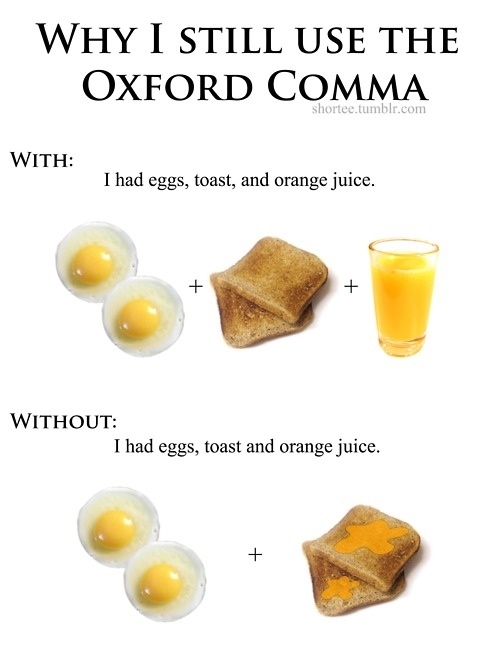
from:http://www.mobypicture.com/user/TheSaraRead/view/10039621/sizes/full
Subscribe to:
Posts (Atom)